Every discussion about performance eventually reaches the same question. Why do some people sustain clarity, resilience, and productivity over decades while others decline despite access to the same tools, knowledge, and opportunities? The answer is often framed in psychological or strategic terms, yet the deeper explanation begins at the cellular level. Energy production governs every function in the human body, and the structure responsible for that energy may be the most overlooked factor in modern conversations about health, leadership, and longevity.
Mitochondria, the organelles responsible for generating cellular energy, sit at the center of nearly every process associated with aging and disease. Research in cell biology has repeatedly shown that mitochondrial dysfunction correlates with neurodegeneration, metabolic disorders, cardiovascular disease, and cancer. A widely cited review in Nature Reviews Molecular Cell Biology describes mitochondrial decline as a critical driver of the aging process because reduced energy production disrupts repair mechanisms, increases oxidative stress, and accelerates damage to DNA, proteins, and lipids.
This is not a narrow medical concern. When energy production falters, every system loses efficiency. Cognitive performance drops. Emotional regulation weakens. Recovery slows. The same biological mechanisms that shape disease risk also influence focus, decision making, and resilience under pressure. The conversation about peak performance cannot remain separate from the biology that makes performance possible.
The Partnership That Made Complex Life PossibleThe Most Important Organelle You Have Never Thought About
The origin of mitochondria offers a useful framework for understanding why energy, connection, and cooperation are inseparable. According to the endosymbiotic theory, a primitive cell once formed a partnership with a free-living bacterium capable of using oxygen to generate energy. Instead of destroying the bacterium, the host cell provided protection, and the bacterium provided fuel. Over time, the two became inseparable. This alliance made complex multicellular life possible.
The lesson extends beyond evolutionary biology. Every level of human function depends on cooperation between systems. Cells form tissues. Tissues form organs. Organs form organisms. Performance emerges from coordination rather than isolation. The same principle applies in organizations. Research on high-performing teams consistently shows that trust and psychological safety predict effectiveness more reliably than technical skill alone, as discussed in Harvard Business Review’s analysis of resilience and performance.
The parallel is difficult to ignore. Life advances through interdependence. Energy flows where systems cooperate..
Mitochondria Respond to Emotional States
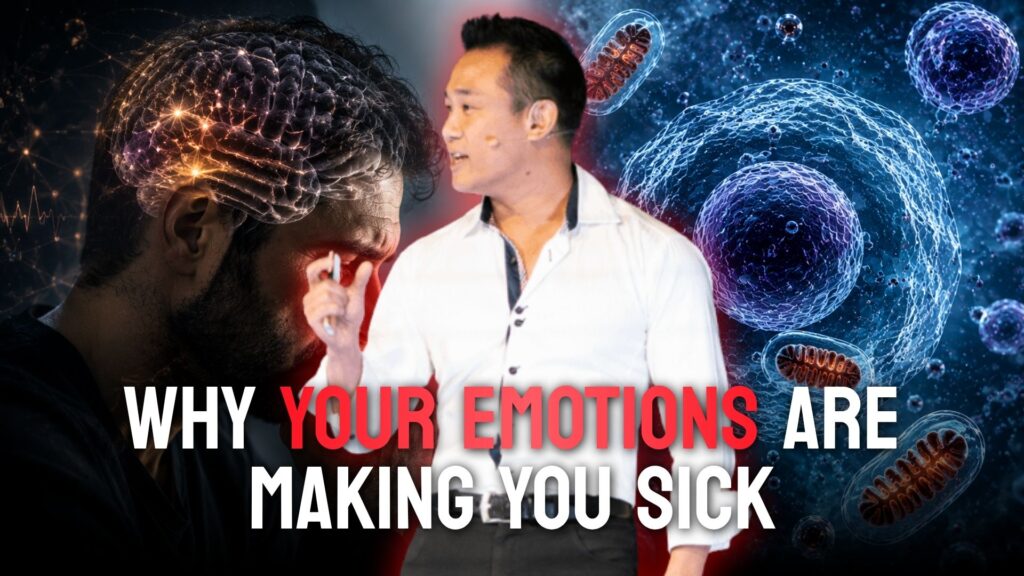
The connection between biology and behavior becomes even more striking when examining how mitochondria respond to psychological experience. A growing body of research in psychoneuroimmunology suggests that emotional states influence cellular function in measurable ways. In one line of research led by Martin Picard at Columbia University and Elissa Epel at UCSF, scientists tracked emotional patterns in caregivers while also measuring mitochondrial activity in blood cells. Negative emotional states correlated with lower mitochondrial efficiency and higher oxidative stress, while positive emotional states correlated with improved energy production.
This finding aligns with broader research showing that stress physiology directly affects immune response, inflammation, and metabolic regulation. A review published in the National Institutes of Health database explains that chronic psychological stress alters mitochondrial signaling and contributes to systemic dysfunction across multiple organs (NIH review on stress and mitochondrial function).
The implication is direct. Energy is not only biochemical. It is also psychological. The internal environment created by thoughts, emotions, and social relationships can either support cellular efficiency or undermine it.
Performance Is an Energy Management Problem
Executives often search for productivity strategies while ignoring the biological constraints that make productivity possible. Focus, creativity, and endurance all require sustained energy availability. When mitochondrial output declines, performance declines regardless of motivation.
Research on workplace performance increasingly supports this view. Studies summarized by MIT Sloan Management Review show that emotional states directly influence cognitive flexibility, problem solving, and decision quality. Similarly, analysis from McKinsey on employee well-being and productivity finds that sustained performance depends on physical health, psychological stability, and social connection rather than effort alone.
These findings mirror what cell biology has already demonstrated. Systems function best when energy supply is stable, damage is repaired efficiently, and signals between components remain clear. When those conditions break down, output falls no matter how strong the intention.
In practical terms, energy management becomes a leadership responsibility. Sleep, nutrition, stress regulation, and emotional stability are not lifestyle preferences. They are performance variables.
The Longevity Paradox
Advances in biotechnology, artificial intelligence, and regenerative medicine continue to extend the boundaries of human lifespan. Futurists and medical researchers are openly discussing the possibility of dramatically slowing aging through gene editing, stem cell therapies, and metabolic interventions. The scientific momentum is real, and the progress is measurable.
Yet a paradox is emerging. As the ability to extend life increases, the ability to sustain vitality does not always keep pace. Longer lifespans do not guarantee higher quality years. More treatment options do not automatically produce more wellness.
Research on motivation and progress offers a useful perspective. A study highlighted in Harvard Business Review’s work on the power of small wins shows that daily experiences of meaning, connection, and forward movement have a stronger effect on engagement than large but infrequent achievements. The same principle appears at the biological level. Cells function best when signals of safety, stability, and cooperation are consistent.
Technology can extend life. It cannot replace the conditions that make life worth extending.
Practical Implications for Leaders and High Performers
The science of mitochondrial health points toward several practical conclusions.
- Energy should be treated as a primary performance metric, not a side effect of productivity.
- Emotional regulation influences biological efficiency, which in turn influences cognitive output.
- Social connection and psychological safety affect physiology as well as morale.
- Recovery is a requirement for sustained performance, not a reward after it.
- Longevity without vitality creates diminishing returns.
Organizations that ignore these principles often see the same pattern. High output in the short term followed by burnout, disengagement, and turnover. Systems that respect biological limits tend to produce steadier performance over longer periods.
The Real Leverage Point
The most important insight from mitochondrial research is not about aging alone. It is about leverage. Every function in the body depends on energy, and energy depends on the conditions that allow cells to operate efficiently. When those conditions are present, repair improves, resilience increases, and performance becomes sustainable. When they are absent, decline accelerates even in the presence of advanced technology.
The future of health and leadership will not be defined only by new treatments or new tools. It will be defined by how well individuals and organizations learn to create environments that support energy at every level, from the cellular to the social.
Life began with a partnership that made greater complexity possible. The same principle still applies. Performance expands where trust, connection, and stability allow energy to flow.
Want to go deeper on the science behind this?
Watch Dr. Vuu break down the full mitochondrial health framework, including the research, the biology of connection, and practical steps to shift your cellular environment, in his full keynote talk.
[Why You’re Always Tired: The Mitochondria Science Behind the Hallmarks of Aging] –> Watch the Full TalkOr explore Dr. Vuu’s book Thrive State for the complete framework on optimizing your biology from the inside out: thrivestatebook.com