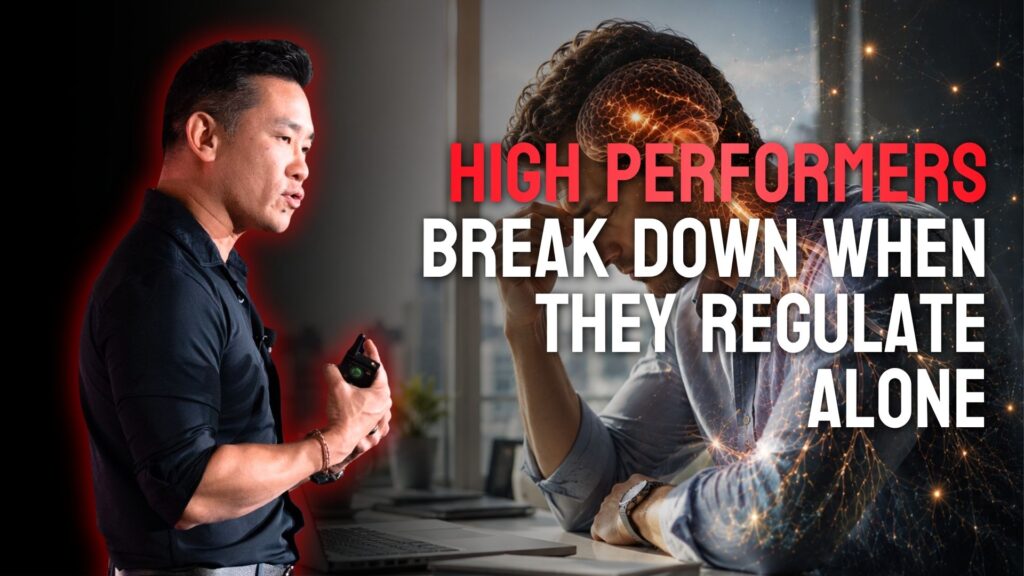
The Biology of Leadership: Why High Performers Cannot Regulate Alone
When pressure rises, accomplished professionals tend to contract.
The instinct feels rational. Handle it privately. Think it through. Protect the team. Maintain composure. High performers are rewarded for self sufficiency, so isolation can masquerade as strength.
Yet biology tells a different story. Human beings are not designed to regulate stress alone. The nervous system stabilizes in the presence of safe connection. Without it, stress compounds, cognition narrows, and recovery falters.
The same physiological signals that shape connection also influence executive presence and nervous system regulation inside leadership environments.
This is not sentimentality. It is measurable physiology with direct implications for leadership, performance, and long term health.
Research available through the National Institutes of Health demonstrates how social support improves physiological recovery from stress.
Your Nervous System Is Always Asking One Question
Safety sits at the center of human regulation. The nervous system continuously scans the environment for cues that answer a single question: Am I safe?
This process, described in Stephen Porges’ Polyvagal Theory and explored in clinical research published through The National Center for Biotechnology Information, operates below conscious awareness. Facial expression, tone of voice, posture, and relational signals are interpreted in milliseconds.
Without relational support, leaders often begin to exhibit subtle leadership burnout signals long before exhaustion becomes obvious.
MIT Sloan Management Review has examined how psychological safety strengthens leadership performance and team learning.
When a leader sits across from someone who feels psychologically safe, several physiological shifts occur:
- Oxytocin increases
- Cortisol declines
- Breathing slows
- Heart rate variability improves
Oxytocin does more than facilitate bonding. It dampens activity in the amygdala, the brain’s threat detection center, and promotes parasympathetic activation, the state associated with repair and restoration. Cortisol, the primary stress hormone, decreases when a person feels socially supported. Chronic elevation of cortisol has been linked to sleep disruption, metabolic dysfunction, and immune suppression.
Many organizations unintentionally reinforce toxic productivity culture by rewarding isolation and constant output.
These shifts are not abstract. They are detectable through biomarkers and cardiac variability measures. Safe connection moves the body from survival physiology to recovery physiology.
The longitudinal evidence is equally compelling. The Harvard Study of Adult Development, one of the longest running studies in history, found that the quality of relationships predicted long term health and happiness more strongly than cholesterol levels or socioeconomic status. Strong social ties correlate with lower rates of cardiovascular disease and increased longevity.
Connection buffers stress. Isolation amplifies it.
Isolation Registers as Threat
From an evolutionary standpoint, separation from the group signaled danger. The modern workplace may look different from ancestral environments, yet the brain’s wiring has not fundamentally changed.
Functional MRI studies demonstrate that social rejection activates the anterior cingulate cortex, a region involved in the perception of physical pain. Research highlighted in Science showed that the neural circuits engaged during social exclusion overlap with those engaged during physical injury.
The implication for leaders is direct. Chronic disconnection keeps the nervous system in defensive mode. Over time, this creates a cascade:
- Persistently elevated cortisol
- Increased inflammatory markers
- Reduced sleep quality
- Impaired recovery capacity
Loneliness has been associated with increased inflammatory cytokines and heightened cardiovascular risk. A meta analysis published in PLOS Medicine found that individuals with stronger social relationships had a 50 percent increased likelihood of survival compared to those with weaker ties.
Executives often focus on inflammation through diet, supplementation, and exercise. Few address relational inflammation. Yet the body responds to emotional isolation as if exposed to threat.
Leaders who appear composed may still be physiologically dysregulated if they lack safe relational anchors. The nervous system recognizes the difference between performing competence and experiencing safety.
The High Performer’s Blind Spot
Achievement culture reinforces independence. Competence becomes identity. Self reliance becomes armor. The higher an individual rises, the narrower their circle of candor often becomes.
Research on psychological safety, popularized in Harvard Business Review in The Fearless Organization, demonstrates that teams perform better when members feel safe to speak openly without fear of humiliation. The same principle applies at the individual level. Leaders require environments where they can express uncertainty without reputational risk.
McKinsey has reported on the rising incidence of executive burnout and emotional strain in its analysis Addressing employee burnout: The role of leadership. Isolation compounds that strain. When leaders regulate alone, stress remains unbuffered.
Consider the founder who runs a high growth company yet has no peer with whom they can speak candidly about fear or doubt. Outwardly stable. Internally hypervigilant. Over time, that hypervigilance shows up as sleep disruption, shortened patience, and reduced strategic clarity.
Cold exposure, supplementation protocols, and biohacking tools cannot substitute for co regulation. Honest conversation in the presence of steadiness alters breathing patterns, heart rhythms, and stress hormone levels in ways no wearable device can replicate.
Connection as a Performance Variable
Performance conversations frequently revolve around optimization. Sleep tracking. Nutritional precision. Cognitive enhancement. These tools have value. Yet relational depth rarely appears on executive dashboards.
Evidence suggests it should. The American Psychological Association has summarized research showing that social support mitigates the harmful effects of stress on health outcomes in its coverage of relationships and health. Individuals with strong support systems exhibit lower stress reactivity and improved immune response.
For leaders, this translates into practical questions:
- Who knows what you are actually carrying right now?
- Where can you speak without curating your image?
- Which relationships help your physiology downshift?
If the answer is unclear, the cost is likely being paid through subtle markers. Elevated resting heart rate. Shallow sleep. Reduced cognitive flexibility. Irritability under pressure.
Organizations can institutionalize relational buffers through structured peer forums, executive coaching grounded in psychological safety, and leadership circles that prioritize candor over performance theater. Individual leaders can cultivate two or three relationships defined by honesty and mutual steadiness.
This is infrastructure.
Leadership research from MIT Sloan Management Review in Why Psychological Safety Matters and What to Do About It underscores that psychologically safe environments drive learning and resilience. The same mechanisms that enable team innovation also enable individual recovery.
Connection is not an abstract virtue. It is a lever for cognitive clarity, metabolic stability, and strategic endurance.
The Strategic Advantage of Being Seen
When pressure intensifies, isolation feels disciplined. It appears controlled. Yet the human organism was not engineered for solitary regulation under sustained stress.
Safe connection lowers stress hormones, enhances immune regulation, and stabilizes cardiac rhythms. It extends lifespan and improves decision making. It restores perspective.
For leaders responsible for complex systems, this carries a final insight. Sustainable performance is relational before it is tactical. The nervous system that feels supported thinks more clearly, recovers more efficiently, and leads more effectively.
Build the circle. Protect the space for honest conversation. Measure relational depth with the seriousness applied to financial indicators.
Connection is not weakness. It is biology. And in leadership, biology always wins.