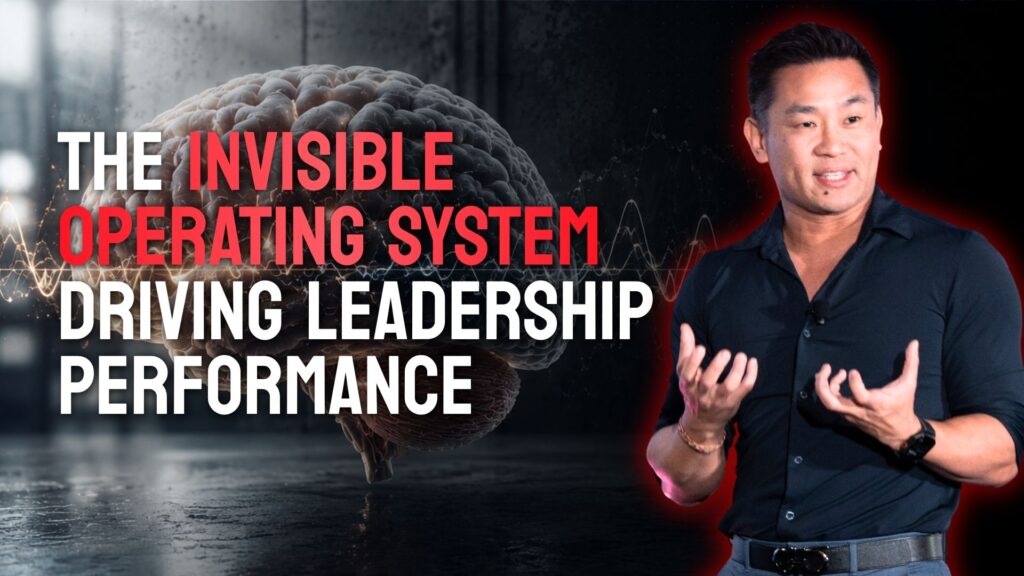
Executives spend billions of dollars refining strategy, optimizing workflows, and upgrading technology. Far fewer examine the internal operating system shaping every decision they make under pressure.
That blind spot has consequences.
Stress does not remain isolated inside the individual leader. It cascades through teams, cultures, and organizations. A leader operating from fear, exhaustion, or unconscious survival patterns sends signals that ripple outward into communication, trust, innovation, and performance.
The emerging science of resilience and neuroscience suggests that leadership effectiveness is less about managing external complexity and more about regulating the internal conditions that shape perception, behavior, and energy.

This perspective is gaining traction across organizational psychology and neuroscience research. Studies on resilience published through Harvard Business School have shown that resilient leadership is rooted in cognitive reframing and emotional regulation, not the elimination of adversity itself. Research on the brain’s default mode network from Frontiers in Human Neuroscience further demonstrates that neural systems tied to empathy, imagination, and self-awareness directly influence leadership behavior.
The implication is difficult to ignore. Organizational performance is inseparable from human nervous systems.
Stress Is Not the Enemy
Corporate culture often treats stress as a pathology to eliminate. The evidence suggests a more nuanced reality.
Stress, in measured doses, is essential for growth. Muscle tissue strengthens through controlled strain. Immune systems adapt through exposure. Elite performers build capacity by recovering from challenge, not avoiding it.
The same principle applies to organizations.
High-performing companies are not defined by the absence of pressure. They are defined by their ability to recover, recalibrate, and adapt without collapsing into chronic dysfunction.
That distinction matters because many organizations have systematically removed recovery from the equation. Endless notifications, meeting overload, digital surveillance, and performative urgency have created environments where leaders remain in a prolonged state of cognitive and emotional activation.
The result is not resilience. It is depletion.
A Harvard Business Review analysis on exhausted workforces noted that sustained stress without adequate recovery reshapes workplace behavior, narrowing perspective and increasing emotional volatility. Similarly, research on burnout published in Harvard Business Review’s work on burnout identified chronic overload as a primary driver of disengagement and reduced cognitive performance.
The challenge for leaders is no longer simply increasing productivity. It is preserving the biological and psychological capacity required for clear thinking.
The Default Mode Network and the Leadership Trap
Neuroscience offers another layer of explanation.
The brain contains a system known as the default mode network, often associated with autobiographical memory, internal narrative, future projection, and social interpretation. Under healthy conditions, this network supports creativity, reflection, and strategic imagination.
Under chronic stress, however, the system can become dominated by survival-based pattern recognition.
Leaders begin interpreting ambiguity as threat. Feedback feels personal. Conflict escalates faster. Control behaviors increase. Empathy narrows.
Research published in The Leadership Quarterly found measurable links between default mode network activity and visionary leadership behavior. Additional work featured in Scientific American’s analysis of neuroleadership suggests that the same neural systems involved in self-awareness and social cognition directly influence transformational leadership capacity.
This explains why technically brilliant leaders can still create toxic organizational environments. Strategy alone cannot override unconscious emotional conditioning.
Many executives are operating with survival adaptations formed decades earlier:
- Achievement as a substitute for worthiness
- Control as protection against uncertainty
- Overwork as validation
- Perfectionism as defense against rejection
- Aggression as armor against vulnerability
These patterns frequently masquerade as ambition.
In reality, they consume extraordinary psychological energy.
Culture Is a Nervous System
Organizations often describe culture as shared values or behavioral norms. A more accurate description may be collective nervous system regulation.
Teams continuously absorb emotional signals from leadership. Calm increases psychological safety. Fear amplifies defensiveness. Trust expands collaboration. Anxiety contracts communication.
This dynamic mirrors biological ecosystems. Signals move downward through layers of interaction. A stressed leader affects direct reports, who affect managers, who affect frontline employees.
The organization begins functioning according to the emotional state most consistently modeled at the top.

Research on organizational resilience from The Quest for Resilience argues that adaptive capacity becomes a strategic advantage during instability. Yet resilience is often misunderstood as toughness or endurance.
Resilient organizations are not emotionally numb. They are responsive without becoming reactive.
That distinction changes leadership priorities.
Instead of rewarding perpetual urgency, leaders must design systems that preserve recovery, reflection, and cognitive flexibility. Instead of glorifying exhaustion, they must normalize sustainable performance.
The Leadership Shift That Matters Most
The next era of leadership development will likely move beyond traditional productivity frameworks.
Technical expertise remains essential. Strategic thinking still matters. But executives increasingly face challenges that cannot be solved through analysis alone:
- Polarized teams
- Chronic burnout
- Trust erosion
- Emotional disengagement
- Decision fatigue
- Rapid uncertainty
These are nervous system problems as much as operational ones.
The leaders who thrive in this environment will not necessarily be the most aggressive or relentlessly driven. They will be the individuals capable of maintaining clarity under pressure while creating psychological steadiness for the people around them.
That requires a shift from unconscious reaction to conscious response.
Practical implications for leaders include:
- Building recovery time into decision-making cycles
- Reducing performative urgency that amplifies organizational anxiety
- Recognizing how emotional states spread through teams
- Developing self-awareness practices that interrupt reactive behavior
- Measuring leadership health alongside operational metrics
- Creating environments where trust increases adaptability
Research from Harvard Business Review’s examination of resilience warns against romanticizing endurance while ignoring emotional cost. Sustainable resilience requires recalibration, not perpetual strain.
The Real Competitive Advantage
Technology will continue accelerating. Artificial intelligence will automate analysis, streamline operations, and reshape industries. Yet one factor remains stubbornly human: the emotional and energetic condition of the people leading organizations.
The future of leadership may depend less on who can process the most information and more on who can remain fully conscious while navigating complexity.
That is the deeper challenge facing executives today.
Every leader projects a signal through behavior, attention, communication, and emotional presence. Teams respond to that signal continuously, whether consciously or unconsciously.
The question is no longer whether leaders influence organizational energy. They already do.
The real question is whether they are aware of the signal they are creating.
Continue the Conversation
For a deeper dive into the concepts explored in this article, watch Dr. Vuu’s video “Heal Chronic Illness by Changing Your Signal”