Stop Forcing Success: Build the Conditions That Let It Happen
Burnout rarely announces itself dramatically.
It accumulates quietly. Creativity thins out in meetings. Decisions feel heavier than they should. Teams remain active, calendars stay full, yet the underlying energy has shifted.
For years in clinical medicine and leadership, burnout appeared to be a simple equation. More hours meant more exhaustion. The assumption seemed rational.
The data tells a different story.
These patterns frequently appear long before obvious leadership burnout signals are recognized.
Research summarized by the National Institutes of Health shows that chronic stress affects immune regulation and metabolism.
Burnout is not purely a function of volume. It is a function of imbalance. Specifically, the gap between output and recovery. Most leaders track performance metrics obsessively. Very few track recovery capacity with the same rigor.
That oversight carries biological consequences.
Harvard Business Review has documented how burnout correlates strongly with lack of recovery and autonomy.
Many organizations unintentionally reinforce toxic productivity culture through constant urgency.
The Performance Metric No One Is Tracking
Organizations measure revenue, growth velocity, market share, and execution speed. Dashboards display KPIs in real time. Forecast models project quarterly outcomes.
Almost no dashboard tracks nervous system load.
Sustainable organizations understand the biology of leadership performance.
Your biology does.
When demand chronically exceeds recovery, the body shifts into protective mode. Cortisol rises. Inflammatory markers increase. Cognitive flexibility narrows. Research summarized by McKinsey & Company shows sustained stress impairs decision quality and long term performance.
Production may continue. Output may even increase temporarily. Yet the subjective experience changes. Work feels heavier. Focus requires more effort. Strategic thinking becomes reactive.
This is the early signal of leadership burnout.
The World Health Organization formally classifies burnout as an occupational phenomenon characterized by exhaustion, mental distance, and reduced efficacy. Research published in The Lancet Public Health links chronic workplace stress to measurable health deterioration.
Burnout is physiological before it becomes behavioral.
High Performers Can Run on Empty for a While
High achievers possess unusual capacity. They can override fatigue. They normalize strain. They interpret stress signals as indicators of commitment.
From the outside, it looks like momentum. Internally, depletion accumulates.
The danger lies in adaptability. The human nervous system can sustain sympathetic activation for extended periods. Eventually, recalibration occurs. Sleep disrupts. Irritability increases. Motivation fragments.
Research from Harvard Business Review highlights that burnout stems less from hours worked and more from lack of control, insufficient recovery, and misalignment with values.
Biology drives behavior. When the nervous system remains in fight or flight activation, the brain reallocates resources toward immediate survival tasks. Creativity declines. Empathy narrows. Long term vision compresses.
Leadership shifts subtly from expansion to maintenance.
This pattern is not weakness. It is neurophysiology.
Burnout Is a Nervous System Imbalance
Chronic stress alters how the brain functions. Prolonged cortisol exposure affects the prefrontal cortex, the region responsible for executive decision making, impulse control, and strategic thinking. The amygdala becomes more reactive. Attention skews toward perceived threat.
Analysis in MIT Sloan Management Review explains how stress diminishes higher order cognition while amplifying defensive behaviors.
The consequences inside organizations are tangible:
- Innovation decreases
- Conflict tolerance drops
- Decision cycles shorten
- Micromanagement increases
What appears to be a strategy issue is frequently a physiological one.
When leaders operate in chronic activation, their internal state transmits to teams. Emotional contagion research demonstrates that stress spreads through groups rapidly. A dysregulated leader scales tension. A regulated leader scales stability.
Burnout therefore becomes cultural, not just individual.
The Burnout Ratio
Sustainable performance requires tracking a ratio rarely discussed in boardrooms: output relative to recovery and alignment.
Three variables determine whether performance compounds or collapses.
1. Output Load
Where is cognitive, emotional, and relational energy directed. Strategic decisions, conflict management, stakeholder pressure, public visibility. All carry physiological cost.
2. Recovery Depth
Recovery is not distraction. It is restoration. Sleep quality. Breath regulation. Physical movement. Silence. Meaningful connection. Research from Stanford University shows recovery practices improve productivity and cognitive resilience.
Without genuine parasympathetic activation, stress chemistry remains elevated.
3. Meaning Alignment
Energy spent in alignment drains differently than energy spent in resistance. A Deloitte survey reported in Deloitte Insights found that employees lacking purpose alignment reported significantly higher burnout rates.
Misaligned success accelerates depletion. Achievement without meaning magnifies stress load.
When output rises while recovery and alignment remain stagnant, the ratio destabilizes.
State Is the Real Leadership Lever
Elite leaders manage more than calendars. They manage physiology.
A regulated nervous system sustains strategic thinking. A recovered brain tolerates ambiguity. A grounded leader stabilizes complex conversations.
Leadership is state transmission.
Neuroscientific research consistently shows that executive function depends on metabolic and emotional stability. Without it, even exceptional talent underperforms.
Increasing recovery produces observable shifts:
- Decision clarity improves
- Emotional reactivity declines
- Creative thinking returns
- Team tension decreases
Performance becomes sustainable rather than volatile.
Sustainable high performance is the true competitive advantage. Intensity can produce short bursts. Capacity produces longevity.
Build Conditions, Do Not Force Outcomes
Many leaders approach success through force. Push harder. Extend hours. Increase pressure.
Force amplifies output temporarily. It also accelerates nervous system fatigue.
A more durable strategy focuses on conditions. Adequate recovery. Clear priorities. Meaningful alignment. Psychological safety. Research on workplace culture published in Harvard Business Review demonstrates the measurable link between well being and productivity.
When conditions support regulation, performance compounds naturally.
The question shifts from endurance to calibration.
Not how much can be handled.
Whether recovery matches responsibility.
A Better Question
Burnout is not random. It follows imbalance.
Ask a sharper question:
Is my recovery matching my responsibility.
If the answer is no, the ratio will eventually correct itself through fatigue, disengagement, or health consequences.
Energy precedes outcomes. Physiology precedes strategy.
Leaders who protect their nervous system capacity protect their organization’s future performance.
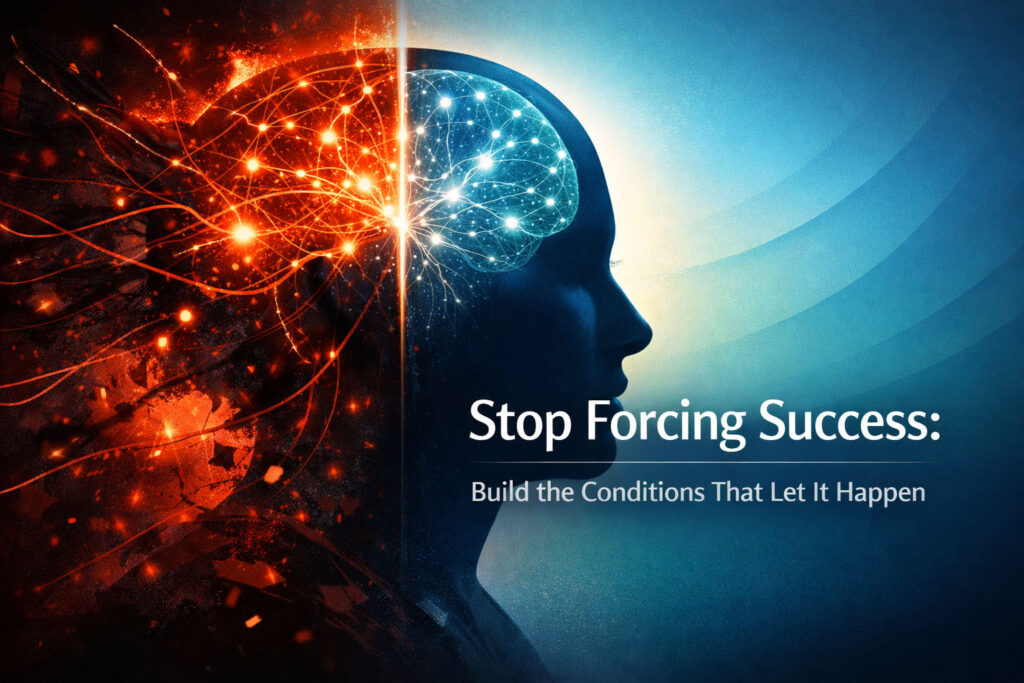
Stop forcing success. Build the biological conditions that allow it to emerge.
Capacity, not hustle, determines longevity.
And longevity is the advantage that endures.