The Most Dangerous Leadership Decisions Happen in Survival Mode
The worst leadership decision I made as a physician did not look reckless.
It looked decisive.
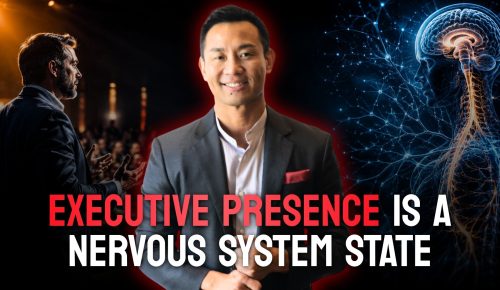
The same physiological dynamics influencing stress and decision making shape leadership behavior during moments of pressure.
High-stakes case. Full room. Time pressure. A junior physician questioned my treatment plan.
MIT Sloan Management Review has explored how emotional contagion spreads through teams and shapes group performance.
My jaw tightened. My chest compressed. Heat rose.
I shut it down.
Leaders who maintain executive presence and nervous system regulation are far less likely to react impulsively in high-stakes situations.
The American Psychological Association notes that stress responses can rapidly shift perception and communication patterns.
Hours later, once my nervous system settled, I saw what I had missed. Not because I lacked expertise. Because I was dysregulated.
Strategy Isn’t the Problem. State Is.
Most leadership failures are not strategic errors. They are physiological ones.
This highlights the importance of understanding the biology of leadership performance inside modern organizations.
We defend instead of inquire. We push instead of pause. We control instead of connect.
Then we label it strength.
Biology drives behavior. Energy precedes outcomes.
Under pressure, leaders do not rise to the level of their intentions. They default to the level of their regulation.
When Your Nervous System Hijacks the Room
When your system detects threat, even social threat, your body shifts instantly.
Heart rate rises. Breathing shortens. Cortisol spikes. Prefrontal clarity drops.
Your reflective brain goes offline. Your survival brain takes the wheel.
Neuroscience research summarized by Harvard Business Review explains how stress impairs executive function and narrows cognitive range. The prefrontal cortex, responsible for strategic thinking and impulse control, becomes less efficient under stress chemistry.
This response is adaptive in emergencies.
It is destructive in leadership.
Boardrooms are not battlefields. Your body often cannot tell the difference.
The Story in Your Head Is Running the Meeting
Under stress, the brain’s Default Mode Network amplifies internal narrative. Old failures resurface. Scarcity stories replay. Past wounds color present dialogue.
You believe you are assessing risk.
Often, you are protecting identity.
Research in social neuroscience, including findings published in Science, shows that social threat activates neural circuits similar to physical pain. When your status or competence feels challenged, your nervous system responds as if survival is at stake.
Leadership is nervous system transmission.
If you are contracted, the room contracts.
Fast Isn’t Always Strong
High performers are conditioned for speed. Move fast. Trust your instincts. Take charge.
Speed has value. Compression does not equal clarity.
When dysregulated, thinking narrows. Creativity drops. Empathy shrinks.
You may win the argument. You lose trust.
You may drive the decision. You damage culture.
Stress spreads. Emotional contagion research, frequently discussed in MIT Sloan Management Review, demonstrates that leaders’ emotional states shape group dynamics and performance.
Survival energy travels quickly.
Survival State Versus Thrive State
Survival State feels tight, urgent, protective.
Thrive State feels regulated, expansive, relational.
In Survival State:
- Dissent feels threatening
- Ambiguity feels dangerous
- Control feels necessary
In Thrive State:
- Dissent becomes data
- Ambiguity becomes space
- Pause becomes leverage
Thrive State is not softness. It is capacity under pressure.
State before strategy. Always.
The Three-Second Space That Changes Everything
Between stimulus and response, there is a space.
That space is not motivational. It is biological.
It is the breath before the email. The pause before the interruption. The moment you notice your body tighten.
Without the pause, you react.
With the pause, you lead.
Research summarized by The American Psychological Association shows that brief breathing interventions can lower stress markers and restore cognitive flexibility within minutes.
Regulation precedes clarity.
The IMPACT Shift: From Reaction to Regulation
You cannot force clarity in survival mode. You regulate first. Then you respond.
I — Interrupt
Notice activation. Tight chest. Urge to dominate.
M — Move
Lengthen the exhale. Shift posture. Slow your tempo.
P — Perspective
What story am I telling. Fact or fear.
A — Ask
What am I missing.
Say more.
C — Choose
Respond from alignment rather than defense.
T — Track
Reinforce what worked.
Neuroplasticity follows repetition. Research from the National Institutes of Health confirms that repeated regulatory behaviors strengthen neural pathways over time.
Pause often enough and pause becomes your default.
He Thought He Was Being Decisive. His Team Felt Threatened.
A CEO I worked with described himself as direct.
His team described him as intimidating.
In tense meetings, his breath shortened. His tone sharpened. He interrupted frequently.
He believed he was driving clarity.
He was transmitting survival.
We began with awareness. Then he adopted one rule.
Before responding, ask one question.
What risk do you see that I might be missing.
The shift was subtle. The results were not.
Decision quality improved. Psychological safety increased. Blind spots decreased.
The strategy did not change.
The state did.
You Don’t Need Less Stress. You Need More Capacity.
Stress is inherent to leadership. Dysregulation does not have to be.
Every triggered moment is a training opportunity.
If defense repeats, defense strengthens. If pause repeats, capacity expands.
Thrive State is trainable.
Longitudinal research such as the Harvard Study of Adult Development shows that emotional regulation and relational stability are core predictors of long-term wellbeing and performance.
When leaders regulate, teams follow.
Leadership is nervous system transmission.
The Real Danger Isn’t Bad Strategy
It is leading from contraction.
In Survival State, you are not choosing. You are protecting.
The most powerful leaders are not the least triggered. They are the most practiced at returning to regulation.
Energy precedes outcomes. Biology drives behavior. State determines whether strategy ever lands.
State before strategy.
Every time.